A Challenge to the rich getting richer while the planet & the poor get poorer
What is the connection between climate change induced extreme weather disasters and extreme wealth? Why do the rich and powerful think that exploiting the earth’s resources will not lead to eventual destruction of the plants and creatures that we NEED to survive? These are questions that have been asked by many people including problem solving thinkers, activists and authors, but not by many of the wealthy or politicians. So, what are some of the alternatives to this ongoingly destructive behaviour? In the current situation of the 2020’s we need to “think global and act local” and find ways of supporting ourselves, not major corporations and billionaires. For example, local community gardens and food rescue schemes are examples of a new approach to our existing form of economics.
There are many other alternatives to economics as we know it which are worth acting upon, such as: New Economy Network Australia (NENA) which has as its foundational Principles:
Ecological Sustainability: That economic activity respects and operates within ecological limits, bioregional health and planetary boundaries, and also supports the regeneration of natural systems and recognises and upholds the inherent rights of nature to exist, thrive and evolve.
Social Justice: That everyone can participate and benefit from economic activity in inclusive and equitable ways and that this requires working in solidarity to address the historical and ongoing marginalisation of certain groups by racism, imperialism, classism, patriarchy, and other systems of oppression.
Democracy: That economic decision-making is participatory, inclusive and transparent and emphasises collective stewardship and management of economic resources, activities and outcomes.
Place-based/ Emphasising Locality: That building strong, local/place-based economies is important for Australia’s communities; rooting wealth and power in place through localised economic activity.
First Nations People in Australia: Working in solidarity with First Nations Peoples’ is vital to creating a new economy in Australia. NENA acknowledges that the sovereignty of the First Nations was never ceded by treaty nor in any other way… NENA also acknowledges and respects the ancient, Earth-centred, steady state economic system that was created and managed by First Nations People across the continent for millennia. (https://www.neweconomy.org.au/about/nena-foundational-principles/).
Circular Economy: At the local level our Blue Mountains Council is seriously taking up the issue of waste to encourage a circular economy (https://www.bmcc.nsw.gov.au/media-centre/council-commits-to-zero-waste ). This requires thinking about the earth in the way we produce, purchase, and dispose of all material goods. It means tackling the enormous problem of overconsumption: the production of material goods that become garbage and poison the land and water. This is something we all need to take seriously. Circular economy in this context aims to enable a zero-waste future and creation of a local network to easily enable the trading/swapping of goods/clothing, such as bHive in Bendigo (https://bhive.coop/ ).
Not-for-profit groups and businesses: There are several local not-for-profit co-operatives in the Blue Mountains. One food co-op: Lyttleton Stores Co-op in Lawson (https://www.lyttletonstores.com.au/ ), where the ACE group originated, was sadly forced to close early 2024 due to the economic downturn. The Blue Mountains Food Co-op in Katoomba (https://bmfoodcoop.org.au/ ) has moved to smaller premises and is successfully selling healthy foods and other goods. Another is the Blue Mountains Renew Co-op which has a focus on improving opportunities to enable expansion of renewable energies in the mountains. These community owned non-profits, aim to function as a benefit to members and community, providing healthy foods and resilience-building environments. To find out more about co-operatives visit Business Council of Co-operatives and Mutuals (https://bccm.coop/about/ ). A local economy helps to have funds circulate within our local economy rather than increasing already obscene corporate profit – thus helping to ensure that no one gets left behind.
Gift Economy: When we share, exchange, give our time, our skills, our tools without involving money, we enter the realm of gift economy. We start developing a spirit of sharing, a spirit of connection, of “it is about all of us!” We start rebuilding community, getting to know neighbours and other locals. It is just a question of focus: not individual gain but benefits for many. The way Aboriginal people have cared for the land and managed it so that it provided food and shelter for over 60,000 years without the use of money is something to celebrate and learn from. People have long engaged in exchanging goods, bartering or sharing excess food and necessities and this still happens today. It can be for example, co-operative child-care with friends or neighbours or sending clothes to fire or flood victims, or volunteering in local groups who help others or care for the natural environment and groups who are working on climate issues, such as Rising Tide.
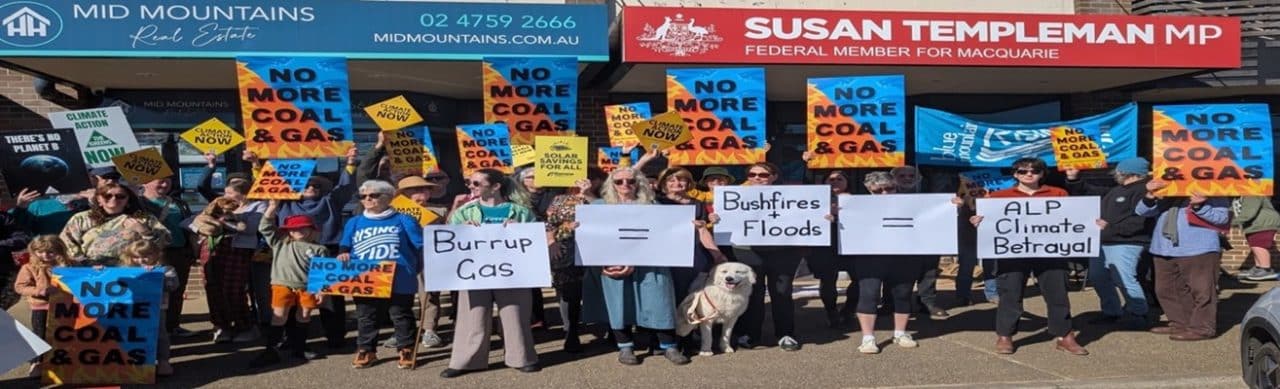
Produced by members of Action for Community and Environment (ACE) in the Blue Mountains, part of Resilient Blue Mountains (Resilient and Circular Economy working group), and Macquarie Alliance for Climate. We are also involved with and support the WSI airport group’s objections to lack of real community consultation, plus rejection of issues raised by community about noise, no curfew and pollution. We are working toward tackling the economic reasons for the serious climate change disasters experienced worldwide, and creating positive change.